Sunspot
A multifunctional shade structure at The University of Texas at Austin
User Research
Product Design

Research & Insights
We began with primary research, interviewing two students with different lived experiences: a Texas-native undergraduate living on campus and an international graduate student living off campus. I collaborated in planning, conducting, and documenting these interviews, ensuring we synthesized findings efficiently within our 6-day timeline.


Synthesizing main ideas from interviews into themes
Through synthesis, one insight became central to our direction:
“Heat is a universal problem, being individually experienced.”
While both students relied heavily on hydration and sun protection, their strategies were shaped by background, familiarity, and privilege. The Texas-native student described heat mitigation as habitual — carrying sunscreen, planning routes, knowing where shade exists. In contrast, the international student described the Austin heat as shocking and destabilizing. She felt unprepared and under-informed, despite receiving heat education as an athlete, not as a student.
We identified three core themes:
Students were carrying umbrellas, electrolyte packets, sunscreen, and water bottles — personal solutions to a systemic environmental issue. This realization prompted a shift in our thinking: instead of designing another product students must carry, what if there could be a solution that served as a holistic system?
Ideation & Concept
As a team, we explored a wide range of ideas: personal cooling wearables, hydration patches, electrolyte vending machines, smart heat-alert devices, and upgraded umbrellas. I helped structure brainstorming sessions, set deadlines, and organize our ideas digitally to maintain momentum during the compressed sprint timeline.
However, we kept returning to a systems-level insight: shaded pathways benefit everyone simultaneously. That reframed our approach from individual products to shared infrastructure.


Moodboarding concepts Prototyping features Workshopping branding
From this pivot emerged the Sunspot, named after the solar phenomenon that creates cooler areas on the sun’s surface.
The Sunspot would be:
A 7-foot-tall shaded structure Equipped with water and crushed ice refill stations at accessible heights
Stocked with mineral sunscreen, chemical sunscreen (inclusive of darker skin tones), and aloe vera
Integrated with motion-activated fans and ultra-fine mist
Designed with educational infographics and QR codes about heat safety
The design addresses the primary needs for shade, immediate cooling via misters, hydration, and sun protection.
I conceptualized and designed the visual assets for the product, including informational graphics and layout systems for the structure’s educational components. We intentionally considered sustainability, accessibility, and maintenance feasibility — sourcing B Corp-certified, reef-safe sunscreen brands and designing refillable cartridge systems to ensure long-term viability.
Prototyping & Testing
Given the sprint format, we followed an iterative design process that moved from detailed sketches to physical models. After utilizing AutoCAD and Miro to plan and structure the features of the station, we developed three physical MVPs:
A first-iteration 1-foot model of the Sunspot structure out of cardboard and acrylic
A larger 2-foot model that allowed us to test user interaction points, such as the ergonomics of the water refill and accessibility of the sunscreen dispensers.
A placement diorama illustrating implementation along Speedway, UT’s primary pedestrian corridor


AutoCAD models and placement diorama
I contributed to the design of both of the physical models and visual presentation assets, ensuring that our prototype communicated scale, usability, and realism.
We conducted observational research along Speedway to analyze traffic patterns, shade gaps, pedestrian density, and proximity to utility ports. Our findings indicated that most students were willing to walk no more than one minute for heat relief access. Based on these insights, we mapped a proposal of 36 Sunspot installations along Speedway.
Through iterative refinement, we intentionally removed unnecessary features (such as snack vending and emergency call buttons) to focus on high-impact, universally useful elements. This constraint-driven iteration strengthened the concept and clarified our value proposition.
Outcome
The final result was a systems-oriented, scalable infrastructure proposal that shifts heat management from an individual survival strategy to a shared campus resource.
The Sunspot addresses:
Immediate physiological needs (hydration, cooling, sun protection)
Informational gaps for new and international students
Equity in outdoor campus accessibility
Environmental sustainability through motion-activated systems
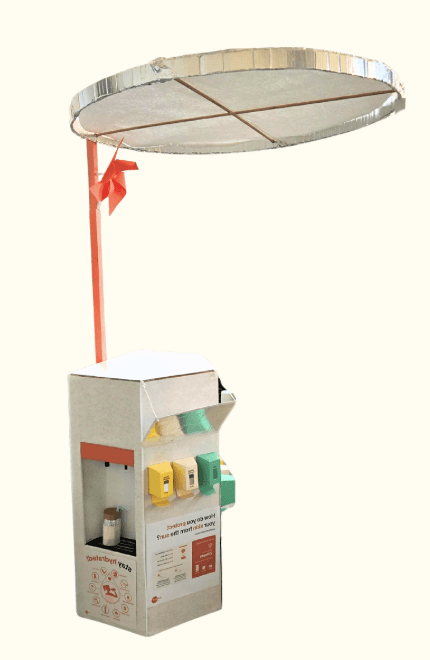
Final 2-foot model
Beyond an on-campus pilot, we aim for expansion potential across Austin and to other universities experiencing similar climate challenges.
From a design leadership perspective, this project highlights my strengths in:
Structuring fast-paced collaborative workflows
Translating research insights into systems-level solutions
Designing clear visual communication assets
Bridging environmental, social, and experiential considerations
This project reinforces the value of rapid, user-centered design, and the importance of translating specific user quotes directly into tangible features. In just six days, we moved from interviews to a fully realized physical MVP, demonstrating how intentional user research and structured collaboration can produce meaningful, infrastructure-scale solutions.
Next Steps
Moving forward, I would want to test the Sunspot at actual scale on campus — observing whether students engage with the stations and how placement affects foot traffic and dwell time.
A temporary, 1:1 prototype would allow us to observe how students naturally interact with the structure: Do they stop to refill water? Apply sunscreen? Seek shade during peak heat hours? How long do they dwell under the structure compared to existing shaded areas?
Testing multiple placements along Speedway would also allow us to assess how proximity to high-traffic buildings, intersections, and existing shade impacts utilization. These insights would inform refinements to feature prioritization, spacing between units, and long-term scalability across campus and beyond.
As climate conditions intensify, the Sunspot offers a scalable model for how universities like the University of Texas at Austin can design proactively for resilience, equity, and everyday comfort.